


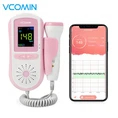

Pregnancy is a journey filled with anticipation as well as change for every woman. Between routine prenatal checkups, many expectant parents choose to use a fetal doppler at home to listen to their baby's heartbeat and gain reassurance. If you're wondering whether a home fetal doppler is right for you, check out our articleWhy Every Mom-to-Be Should Consider a Home Fetal Doppler. However, there are times when the heartbeat cannot be detected using a fetal doppler, which can understandably lead to worry and self-doubt-is something wrong with the baby, or am I using the device incorrectly?
Reasons Why You Might Not Hear the Heartbeat
Here is an important point to keep in mind first: in most cases, not hearing a fetal heartbeat does not indicate a problem.Based on clinical guidance and usage feedback from vcomin fetal doppler users, this situation is more commonly related to factors such as gestational age, fetal position, maternal anatomy, or operating technique, rather than the baby's health itself.
Below, we combine clinical knowledge with real-world experience from vcomin fetal doppler users to outline 7 most common reasons, why a heartbeat may be difficult to find, along with practical steps you can take at home to use a fetal doppler with greater confidence.
It May Be Too Early in Pregnancy
This is the most common reason when using a home fetal doppler, especially for first-time users. In early pregnancy, the fetus is very small and the heart sits deep within the pelvis. Even in clinical settings, detecting the heartbeat consistently can be challenging. With a handheld fetal doppler at home, this is even more common.
In general:
9–11 weeks: The success rate of hearing the fetal heartbeat is low
Around 12 weeks: Some expectant mothers may hear the heartbeat
14–16 weeks: Hearing the fetal heartbeat becomes significantly easier.
If your menstrual cycle is irregular or ovulation occurs later than usual, the actual gestational age may be shorter than expected. This can also affect the test results.
Recommendation:
- Avoid setting expectations that you must hear the fetal heartbeat too early.
- Try testing the fetal heart rate again after 1-2 weeks.
- Always rely on prenatal checkups as the primary reference
The Baby Is Still Small and the Signal Is Weak
A fetal heart rate doppler needs the right position and angle to receive a clear reflected heartbeat signal. When the baby is still small and the heart is not yet strong, even correct use of a baby doppler may result in faint or intermittent sounds. This is normal in early pregnancy.
Try the following:
• Slow down during operation and avoid applying excessive pressure.
• Move the probe gradually so the device has enough time to capture the signal.
• As pregnancy progresses, the heartbeat generally becomes easier to detect.

Posterior Uterine Position
Some women have a retroverted or retroflexed uterus.In this case, the uterus is positioned farther from the abdominal wall, which can make it more difficult for the probe to detect the fetal heart rate signal. As pregnancy progresses and the uterus enlarges, the fetal heartbeat typically becomes stronger, and this effect usually diminishes naturally.
Suggestions:
• Adjust your posture, such as leaning slightly backward or lying on your side.
• Start searching from a lower area of the lower abdomen.
• Be patient and avoid changing positions too frequently.
Abdominal Fat Affects Signal Transmission
When there is a thicker layer of abdominal fat, ultrasound signals may weaken as they pass through the tissue, which can affect how clearly the fetal heartbeat is heard. This is a physical factor and is not related to the baby's health.
Operating tips:
• Use enough gel to ensure good contact between the probe and the skin
• Avoid moving the probe too quickly or sweeping back and forth over a wide area
• Use the fetal doppler in a quiet environment to make the sounds easier to distinguish
Placental Position or Interference from Placental Blood Flow Sounds
In some cases, the sound of blood flowing through the placenta may mask the fetal heartbeat or be mistaken for it. This is especially common when the placenta is positioned at the front of the uterus (anterior placenta).
Generally:
• Placental blood flow sounds have a slower rhythm and sound like a continuous "whooshing" sound
• The fetal heartbeat is faster, more regular, and sounds like a strong, rhythmic "thump-thump"
• With increased experience, these two sounds will become easier to distinguish
Operating Method or Fetal Doppler Settings Issues
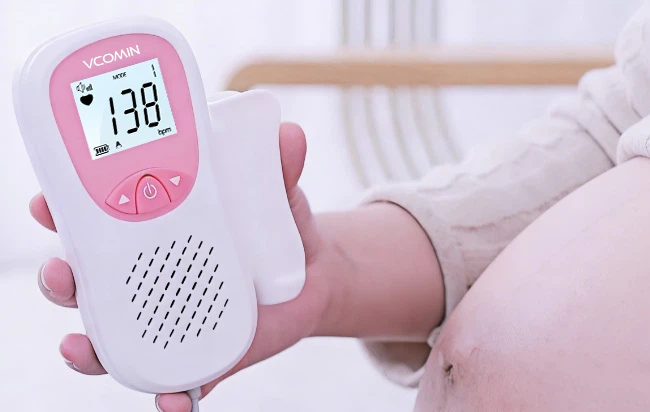
Even for the same expectant mother, the experience can vary from one time to another. Factors such as volume level, battery power, and probe angle can all affect the results. Before using a fetal heart rate doppler, it is recommended to check:
• Whether the battery level is sufficient
• Whether the volume is set at a comfortable level
• Whether the probe is held at a slight angle rather than pressed straight down
• Whether the environment is quiet, with minimal background noise
• Whether enough gel has been applied
The vcomin fetal doppler features a high-sensitivity medical-grade probe, making it easier to capture fetal heart signals at home. Its compact design, simple operation, waterproof probe, and built-in speaker help deliver clear, natural heartbeat sounds. Certified to ISO 13485, CE, and FDA standards, it offers both reliability and safety for added peace of mind.
Your Baby May Be in a Resting Phase
The fetus also has its own activity rhythm. During relatively quiet periods, the fetal heart signal may be weaker, or the position may be unfavorable, making it difficult to detect the fetal heartbeat.
You can try:
• Using the fetal doppler at a different time , such as after waking up in the morning, after lunch, or before going to bed
• Trying again after a few hours
• Avoiding repeated checks within a short period
• Giving both yourself and your baby time to relax
If you can't hear the fetal heartbeat at home, remember these points
• Do not try repeatedly or for extended periods
• Adjust your body position and probe placement
• Use the gel and device correctly
Remember: a fetal doppler is a supportive tool and should not replace regular prenatal checkups.
When Should You Consult a Doctor
It is recommended to contact a healthcare professional if:
• You are in the second or third trimester and still cannot hear the heartbeat after multiple attempts
• You experience abdominal pain, bleeding, or a noticeable decrease in fetal movement
• You continue to feel anxious or uncertain about the results
Word from VCOMIN
The true value of a fetal doppler is to provide a reliable, professional way to monitor fetal heartbeats-without adding unnecessary complexity. Equipped with a high-sensitivity medical-grade probe , the vcomin fetal doppler delivers stable performance in both home and clinical settings. With ISO 13485, CE, and FDA certificates, quality and safety are assured.
If you would like more information about product specifications, purchasing options, or partnership opportunities, please feel free to contact the VCOMIN professional team. We are happy to provide detailed support and assistance.